Can You Use Cryptocurrency to Qualify for a Mortgage?
Key Takeaways
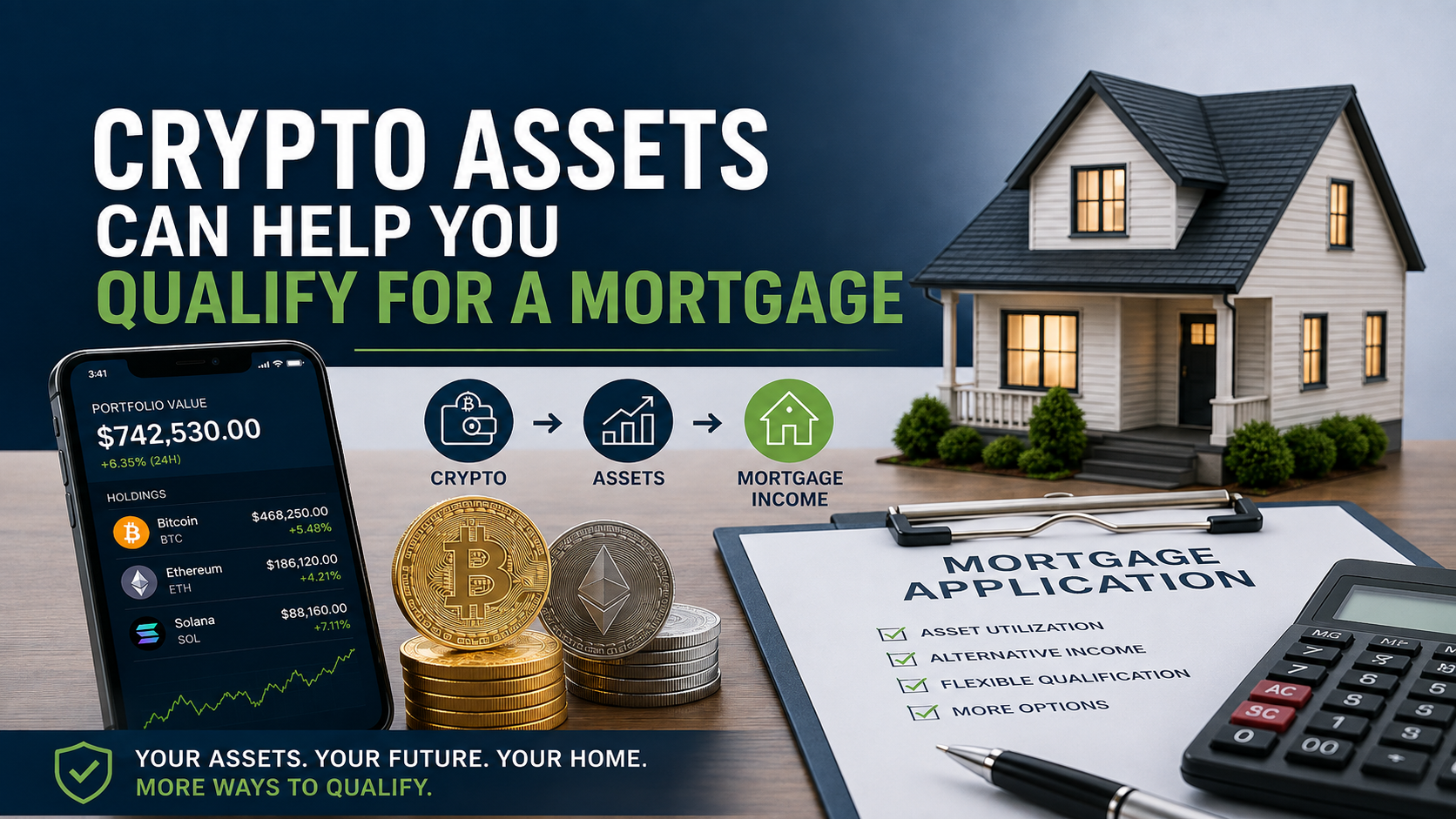
- Some mortgage programs may allow verified cryptocurrency to be included as part of an asset-based income calculation.
- Traditional W-2s, tax returns, or employment verification may not be required for the asset utilization income calculation.
- Eligible assets are converted mathematically into monthly qualifying income.
- Cryptocurrency may need to be converted to cash if it will be used for the down payment or closing costs.
- Crypto does not eliminate normal underwriting requirements.
- Program rules vary significantly by lender.
For many borrowers, mortgage qualification starts with income.
The lender looks at W-2s, pay stubs, tax returns, or other traditional income documentation and determines how much monthly income can be used to qualify.
But what happens when someone has substantial assets and relatively little traditional income?
That situation is becoming more common, especially among investors, self-employed borrowers, retirees, and people who hold a significant amount of cryptocurrency.
Certain asset utilization mortgage programs may provide another way to qualify.
What Is an Asset Utilization Mortgage?
An asset utilization mortgage is designed for borrowers who have meaningful financial assets but may not have enough traditional income to qualify for the loan they want.
Instead of relying entirely on employment income, the lender looks at eligible assets and converts a portion of those assets into a monthly income figure.
Depending on the program, eligible assets may include:
- Cash
- Brokerage accounts
- Stocks
- Bonds
- Retirement accounts
- Cryptocurrency
- Other approved financial assets
The exact assets that qualify and the percentage of each asset that can be used depend on the lender’s guidelines.
How Can Cryptocurrency Be Used?
Some non-traditional mortgage programs specifically allow cryptocurrency to be considered as part of the borrower’s eligible assets.
The crypto holdings generally must be properly verified.
That may include documentation showing:
- Ownership of the account
- Current asset value
- Account history
- The source of the funds
- Transfers between crypto exchanges and bank accounts when applicable
The lender then applies its own guidelines to determine how much of the verified cryptocurrency can be used in the qualifying calculation.
How Asset-Based Income Is Calculated
Asset utilization programs do not usually treat the entire balance of an investment account as monthly income.
Instead, the lender applies a formula.
A simplified example might look like this:
A borrower has $500,000 in eligible assets.
The lender determines that $300,000 of those assets can be used for qualification after applying its required asset percentages, subtracting funds needed for closing, and accounting for required reserves.
If the program divides eligible assets over 60 months:
$300,000 ÷ 60 = $5,000 per month
The lender may then use $5,000 per month as qualifying income.
The exact formula varies by lender and program.
Why Would Someone Use Crypto Instead of Traditional Income?
Consider a borrower who has accumulated significant cryptocurrency over several years.
The borrower may have:
- $700,000 in digital assets
- $200,000 in brokerage accounts
- Strong credit
- A substantial down payment
But their tax returns show only $70,000 in annual income.
A traditional mortgage may have difficulty supporting the loan amount the borrower wants because the taxable income is relatively low.
An asset utilization program may allow the lender to evaluate the borrower’s overall financial strength differently.
That does not mean the borrower automatically qualifies. It simply creates another method of documenting the ability to repay.
Do You Have to Sell Your Cryptocurrency?
Not necessarily.
If the cryptocurrency is being used as part of the asset utilization calculation, the borrower may be able to keep the investment in the crypto account, depending on the lender’s requirements.
That changes if the crypto is needed for:
- Down payment
- Closing costs
- Cash required to close
In that situation, the borrower generally needs to convert the cryptocurrency into U.S. dollars and move the funds into an acceptable financial account.
The lender will usually want documentation showing the transaction from the crypto account through to the bank account. Large unexplained deposits can create additional underwriting questions, so the transaction should be documented carefully from the beginning.
Agency and Non-QM requirements are not necessarily the same. For example, Fannie Mae’s virtual currency guidelines require cryptocurrency to be exchanged into U.S. dollars and verified in an eligible financial institution before those funds can be used for down payment, closing costs, or reserves.
Individual Non-QM asset utilization programs may have different requirements.
Can Crypto Be Used for Reserves?
Depending on the program, verified cryptocurrency may also be considered when calculating required reserves.
Reserves are assets the borrower has remaining after closing.
For example, if the lender requires six months of reserves, it may want to see enough eligible assets remaining to cover six months of the required housing payment.
Whether cryptocurrency can be counted, and how much of its value can be used, depends on the particular lender’s guidelines.
Have Assets but Not Enough Traditional Income?
Mortgage qualification does not always have to start and end with W-2 income or tax returns. Asset utilization, bank statement, DSCR, and other Non-QM programs may provide additional ways to structure a loan depending on your assets, property, credit profile, and overall scenario.
Explore Mortgage OptionsWho Might Benefit From This Type of Loan?
Asset utilization can be especially useful for borrowers whose financial situation does not fit neatly into traditional mortgage underwriting.
Cryptocurrency Investors
Someone may own a large amount of Bitcoin, Ethereum, or other digital assets but show modest employment income.
Retirees
A retiree may have significant savings, retirement accounts, and investment assets but limited monthly pension or Social Security income.
Self-Employed Borrowers
A business owner may legally reduce taxable income through legitimate business deductions, resulting in lower qualifying income on tax returns.
Investors and Entrepreneurs
Some borrowers intentionally keep a relatively low salary while building wealth through investments.
In each of these situations, the borrower may be financially strong even though traditional income documentation does not tell the whole story.
Asset Utilization Is Different From a Bank Statement Loan
These programs are sometimes confused.
A bank statement mortgage generally analyzes deposits into personal or business bank accounts to determine income.
An asset utilization mortgage instead looks at the borrower’s existing assets and converts eligible assets into monthly qualifying income.
The two programs solve different problems.
A self-employed borrower with strong recurring deposits may be better suited for a bank statement loan.
A borrower with substantial investment assets but relatively little income may be better suited for asset utilization.
Crypto Does Not Mean No Documentation
This is one of the most important points.
An asset utilization mortgage is not a no-documentation loan.
The documentation is simply different.
Instead of documenting income through W-2s or tax returns, the borrower may need extensive documentation of assets.
The lender may review:
- Account statements
- Asset ownership
- Asset values
- Transaction history
- Funds required to close
- Required reserves
- Credit history
- Monthly debts
- Property value
- Loan-to-value
- Occupancy
- Property type
The underwriting still needs to make sense.
A Mortgage Is More Than One Number
A borrower may have substantial cryptocurrency and still not qualify for a particular mortgage.
At the same time, someone who assumes they cannot qualify because their tax returns show limited income may actually have several options.
That is why I look at the entire financial picture.
The important questions include:
- What property are you buying?
- How much do you want to put down?
- What monthly payment are you comfortable with?
- What traditional income can be documented?
- What assets do you have?
- How much cash do you want to keep after closing?
- What debts are you carrying?
- What does your credit profile look like?
Sometimes the answer is asset utilization.
Sometimes it is a bank statement mortgage, DSCR loan, conventional loan, or another Non-QM program.
The goal is to find the structure that best fits the borrower and the property.
The Bottom Line
Cryptocurrency has created a financial situation that traditional mortgage underwriting does not always handle well.
A borrower may have substantial net worth while showing relatively modest taxable income.
Asset utilization mortgages provide another way to evaluate that borrower by converting eligible assets into qualifying income.
For borrowers with significant cryptocurrency, investment accounts, retirement assets, or cash, it may be worth exploring asset utilization before assuming traditional income is the only way to qualify.
Frequently Asked Questions
Can Bitcoin be used to qualify for a mortgage?
Potentially. Some asset utilization mortgage programs allow verified cryptocurrency holdings to be included in the qualifying calculation. Eligibility and the calculation method depend on the lender and program.
Do lenders count 100% of my crypto?
Not necessarily. A lender may apply a reduced percentage or other adjustment to cryptocurrency when determining eligible assets. The amount that can be used varies by program.
Do I have to sell my cryptocurrency?
Not necessarily when cryptocurrency is being used for an asset utilization calculation. If the crypto is needed for the down payment, closing costs, or other cash required at closing, conversion to U.S. dollars and documentation of the transfer may be required.
Are tax returns required for an asset utilization mortgage?
Some asset utilization programs do not require tax returns for the income calculation. Other documentation and underwriting requirements still apply, and individual program guidelines vary.
Can cryptocurrency be used for mortgage reserves?
Depending on the lender and program, properly verified cryptocurrency may be eligible for some reserve calculations. The lender may also apply a reduced value or other requirements.
Is an asset utilization mortgage the same as a bank statement loan?
No. A bank statement loan generally uses qualifying deposits to establish income. Asset utilization uses eligible existing assets to calculate qualifying monthly income.
Can I combine cryptocurrency with other assets?
Potentially. Cryptocurrency may be combined with cash, brokerage accounts, retirement assets, or other eligible assets depending on the specific program guidelines.
Important: Asset utilization formulas, cryptocurrency eligibility, acceptable exchanges or custodians, documentation requirements, reserve requirements, loan amounts, loan-to-value limits, property eligibility, and underwriting guidelines vary by lender and program and are subject to change. Cryptocurrency values can also fluctuate significantly. Not all borrowers, properties, assets, or transactions will qualify.
All loans subject to approval. Equal Housing Lender.